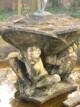
Georg Kolbe
Tänzerinnen Brunnen [Dancer’s Fountain]
1922, photographed 9.2.2025
Oh Georg, what do you know about yourself?
„Paranoia knows some things well and others poorly“
–Eve Kosofsky Sedgwick
Oh Georg, your fountain from 1922 has ended up on my desk. There are several reasons for that, but one surely is that it is problematic. You’re probably problematic yourself too. In 2025, the Georg Kolbe Museum will celebrate its seventy-fifth anniversary, eighty-one years ago you were on the Gottbegnadeten-Liste (Divinely Gifted List), and eighty-seven years ago, you gifted Hitler your It-Piece, a bust of Francisco Franco, reproduced twenty-four times. I’ll tell you right away: I’m not the customer defending this fountain, which was delulu from the start. I won’t start 2025 with “the beauty of abstract body lines, dynamic like a branch in the wind,” or similar reassurances for uninvolved readers. Instead, I prefer to engage with you directly, so as not to give the impression that someone other than you need to be taught here.
Part of me thinks that it would be best for you and the fountain if you were simply forgotten. Yet now artists, a university seminar, and a school class are writing about this work. It’s being researched, rediscovered, and restored. It’s being discussed, listened to, with explicit inclusion of minorities – at least until a black-blue coalition places it in front of the Chancellery. I’m sure: No one will protect you from a new instrumentalization by the far-right. Or do you believe the Berliner Theaterclub, or the museum team will chain themselves to the dancer’s thigh gap to prevent its removal? Because the possibility of its instrumentalization lies in the design of the fountain itself.
I write from a world where women generally do not dance naked on a massive stone basin supported by three humiliated figures. I feel no emotion when I look through the dancer’s legs, which you so prominently placed at eye level with the viewers. I also don’t have the patience to relate every crude expression of heterosexual desire to myself and take it personally. And yet, I get the feeling that I’ve been asked to write this text to introduce another nuance of discomfort into the reception history. I can’t write my text without irritation, but I believe that something about the fountain can teach us something about a better present – precisely because it is problematic.
I get it, you wanted to take a risk with the fountain. And you put thought into it, with rather naïve results. Above, a naked figure dances in an exalted pose. It starts with the title Dancer’s Fountain. Georg, in Berlin “one does not gender on sight.” I learned that (and the whole room) at an event when a moderator referred to someone in the audience as “the woman back there.” So how should we talk about the naïve feminine beauty of this figure? About the doll-like simplified contours from chest to stomach, about the flash-like pose in which she froze. Perhaps allegorically? But at first glance, the overall composition seems like a solidified hierarchical relationship that, no matter how I turn and twist it, somehow sullies the beauty of the dancer.
What’s going on down there, Georg? Is this base really necessary? In your sketches, various arrangements appear: crawling and crouching figures, sometimes in one, sometimes in two tiers beneath the dancer. Sometimes exoticized women, sometimes Black youths. Before you ask: neither has aged well. And you even managed several times to simply leave out the lower levels. The long story short: Below are “the Others.” Both parts originated from your male fantasy. A desperately lost femininity dancing above, a rejected, displaced physicality below. If that is compulsive, it could almost evoke pity. After all, the ability to express one’s own desire without displacing others is a universally desirable goal—and for men of your generation, often unattainable. All the figures seem to avoid the water. Above, the lady dances almost primly between the umbel-like fountains. Below, they shield themselves from the droplets. And I laugh at myself with my clumsy psychoanalytic questions: Why aren’t the bodies getting wet? What’s spraying from the flower? Why doesn’t the clunky, lotus-like basin hold water?
It’s easy to write from my perspective. I could go on, but I wonder if the critique’s demand should not also be to formulate one’s own desire positively and without sharp rejections. I would like to recommend Eve Kosofsky Sedgwick’s text Paranoid and Reparative Reading, or, You’re So Paranoid, You Probably Think This Essay Is About You¹ to you and to myself. There, the author says quite a bit about a paranoid mindset that has a lot to do with the current classification as “problematic.” For Sedgwick, a paranoid reading is marked by a potentially endless and self-confirming thought process that predicts the worst possible outcome. This spreading thought is characterized by the avoidance of negative surprises—both in the past and the future—and thus a paranoid reader “never paranoid enough.” At the same time, paranoid thinking uncritically relies on “exposure,” but the assumptions behind it remain underexplored: “The paranoid trust in exposure seemingly depends […] on an infinite reservoir of naiveté in those who make up the audience for these unveilings. What is the basis for assuming that it will surprise or even disturb, never mind motivate, anyone to learn that a given social manifestation is artificial, self-contradictory, imitative, phantasmatic, or even violent?”
Similarly, the judgment that a certain work is “problematic” goes far. At first glance, I can easily understand such an assessment, but it remains unclear how to proceed with this judgment and the affected work. Sedgwick argues that there’s an incomplete and self-limiting perspective: “The monopolistic program of paranoid knowing systematically disallows any explicit recourse to reparative motives, no sooner to be articulated than subject to methodical uprooting. Reparative motives, once they become explicit, are inadmissible in paranoid theory both because they are about pleasure (‘merely aesthetic’) and because they are frankly ameliorative (‘merely reformist’). What makes pleasure and amelioration so ‘mere’? Only the exclusiveness of paranoia’s faith in demystifying exposure: only its cruel and contemptuous assumption that the one thing lacking for global revolution, explosion of gender roles, or whatever, is people’s (that is, other people’s) having the painful effects of their oppression, poverty, or deludedness sufficiently exacerbated to make the pain conscious (as if otherwise it wouldn’t have been) and intolerable (as if intolerable situations were famous for generating excellent solutions.”
But how could a reparative approach to your fountain look like, Georg? Many men are currently busy downplaying their early work as less problematic than it obviously was. I think it’s possible to outline what’s difficult about the work without completely resigning to an eye-rolling indifference that thinks it is critically uncovering something, but which gives neither you, the depicted beings, nor the viewers much. And to do so in a way that is at least partially reparative and restorative.
My first attempt was a rigorous queer reading. Male gaze, desire, expectation, family, heterosexual matrix, not feeling it. Then I thought of Susan Sontag’s Against Interpretation². “It doesn’t matter whether the artists want their works to be interpreted or not.” Then bronze would be bronze, and the stones would be stones. It would be obvious that the materials weather differently. Above, I’d see the slightly chalky dirt on the dark surface in the sunlight. Below, the coarser texture of the stone, the flaky lichens on the hairlines, and I wouldn’t ask whether they belong to a woman or a youth. How can a work in this form be “about” something that lies beyond this rough contrast of the materiality of the shapes? Any thought that relies on “nothing about us without us” would struggle to find a foothold on these surfaces. It would remain unclear how to speak about people made of stone and bronze. The power is in the viewer, well.
Georg, the dancer would have been better left to endure time alone. Then we could jovially say today, “Ah, how beautiful, just like the one in the pavilion.” But what remains objectionable about the fountain is your decision to make both the basin and the crouching figures from travertine. You’ll have to come up with your own take on that. You even made an effort with them. They cover their chests and genitals with their elbows, each body holding its arms and legs in its own posture. They don’t want to be seen like that, they look down, avoiding the viewer’s gaze. It remains strangely open who or what they are.
Some hope lies in these small, sharp tongues. The crouching figures might not be necessary for the fountain’s structure. Between their backs, strange, oval, tapering shapes protrude. Are they part of an abstracted calyx or a capital that sits on the hexagonal base and directs the weight of the basin into the ground? If you want to lean really far out of the window, you could claim that the crouching figures don’t have to hold the basins’s pressure, you could point to their relaxed, bent feet and say they could stand up without causing the fountain to collapse.
A realization I learned from dealing with the fountain was not created by you, Georg, but by the people who see the world with different eyes: The fountain belongs to the past. It has little to do with the present and the future. And that’s the best thing that could have happened to it. I don’t need to ask you, “Would you make it again today?” I don’t need to shed new, shocking insights on it for the viewers, casting it in a new light that radiates into the present. Perhaps the fountain is an object that unintentionally questions when criticism should begin and when it can end. There’s nothing to be learned from the fountain about social inequalities that wasn’t already known and could be stated more clearly elsewhere. It presses with its staggering carelessness the question of how far one wants to descend into the rabbit hole of self-confirming thinking. Maybe a relaxed peace with it is possible if you and the viewers look at it and think, “It was different back then,” without forgetting its beauty or its flaws. Then it could be a little more indifferent. And afterward, we could come to other thoughts together.
¹ Eve Kosofsky-Sedgewick Paranoid Reading and Reparative Reading, or, You’re So Paranoid, You Probably Think This Essay Is About You. In: Touching Feeling. Affect, Pedagogy, Performativity. Duke University Press. Durham. 2003.
² Susan Sontag Against Interpretation. In: Against Interpretation and Other Essays. Farrar, Straus and Giroux. New York City. 1966.
Published in Der Brunnen. The Fountain. Hg. von Kathleen Reinhard/Georg Kolbe Museum. Translated by Julia Reity. DISTANZ Verlag. 2025.

Georg Kolbe
Tänzerinnen Brunnen [Dancer’s Fountain]
1922, photographed 9.2.2025